
Social Media

From the field

The same posts we share on social media pilot milestones, product news, and what we're building collected in one place.

Social Media Updates

LinkedIn

Autonomous Execution Overview: Real Developments in Technology

This overview focuses on actual advancements rather than just announcements in the field.

1. Voice Technology Trends. The market is quickly shifting towards cloud-based, no-code, cloned voice solutions, while incidents of fraud are increasing. On July 1, xAI launched the Grok Voice Agent Builder, a no-code platform that can set up a production phone agent in approximately two minutes, costing $0.05 per minute plus $0.01 per minute for telephony. They also added 21 new voice options on July 7. During this same period, the FBI reported around $893 million in AI voice-enabled fraud. The key takeaway here is that deploying cloned voice agents has become trivial, leading to an increased fraud risk. Implementing a deterministic, on-device calling agent equipped with local speech-to-text and text-to-speech capabilities can mitigate both outage risks and impersonation threats. Additionally, exercise caution regarding xAI’s reported benchmark lead of 67.3% on the “tau-voice Bench,” which is a test created and administered by xAI itself without independent verification.

2. Cleaning Robot Market Developments. On July 15, IDC announced Gausium as the world’s number one commercial cleaning robot supplier, based on shipments and revenue. This market, valued at approximately $760 million, has seen a year-on-year growth of 48.5%. The focus is shifting from major flagship wins to scalable robots that combine multiple functions and can be deployed immediately while also self-maintaining. The key takeaway is that hardware consolidation supports an integration-layer strategy by providing reliable and commoditized supplies. However, it’s important to note that a $760 million global market does not equate to the $90 billion projection for 2035 that some presentations misleadingly imply is current. If one supplier dominates shipments, differentiation cannot rely solely on the robot itself; it must also focus on fleet operations, integration, and the auditing processes around them.

3. Consolidation of Autonomous Mobile Robots (AMR). AMR platforms are becoming unified fleets. The mid-2026 robotics roundup (held on July 15) highlighted record attendance at Automate 2026, with over 50,000 registrants and 1,230 exhibitors. ABB introduced the Flexley Stack F712, a visual SLAM (Simultaneous Localization and Mapping) forklift, designed for integration with its tugs and movers while offering a singular interface for mixed fleets and claiming 20% faster commissioning. OMRON introduced heavier units, the LD-150 and LD-300. The current theme focuses on the transition from pilot projects to coordinated, multi-site fleets. The key takeaway is that major players are competing based on platform breadth and unified orchestration. New entrants should focus on targeting brownfield, region-specific, service-backed deployments in buildings not prioritized by platform vendors, emphasizing ownership of specific facilities over directly competing with large global fleets.

4. Insights on Aerial Inspections. An analysis this week emphasized that the true value in aerial inspections is shifting from the drone technology itself to the supporting software and sensors. The aim is to conduct repeatable autonomous missions that contribute to digital twins and enable predictive maintenance, rather than relying solely on one-off flights. Regulatory developments are facilitating this shift, as Beyond Visual Line of Sight (BVLOS) pathways are evolving towards routine operations by 2027. The core insight is to partner-source the airframe but retain ownership of the inspection AI, reporting, and integration with work-order systems. It’s essential to focus on asset-condition intelligence rather than just surveillance. In the Gulf Cooperation Council (GCC), this perspective goes beyond branding; it’s crucial for compliance with GCAA/SIRA regulations.

Overall Theme. This week’s developments indicate that hardware is becoming commoditized, and platforms are consolidating. A defensible strategy lies in the integration and execution layer the system that effectively connects a partner-sourced robot to a specific building, intended use case, and regulatory environment. In the Gulf region, this approach involves ensuring compliance and audit-grade coverage, rather than promoting job displacement. This is the direction we are pursuing at AiRK Robotics.

#Robotics #AutonomousMobileRobots #AMR #VoiceAI #DroneInspection #CleaningRobots #WarehouseAutomation #FacilityManagement
View original post ↗
LinkedIn

Developments in Autonomous Execution

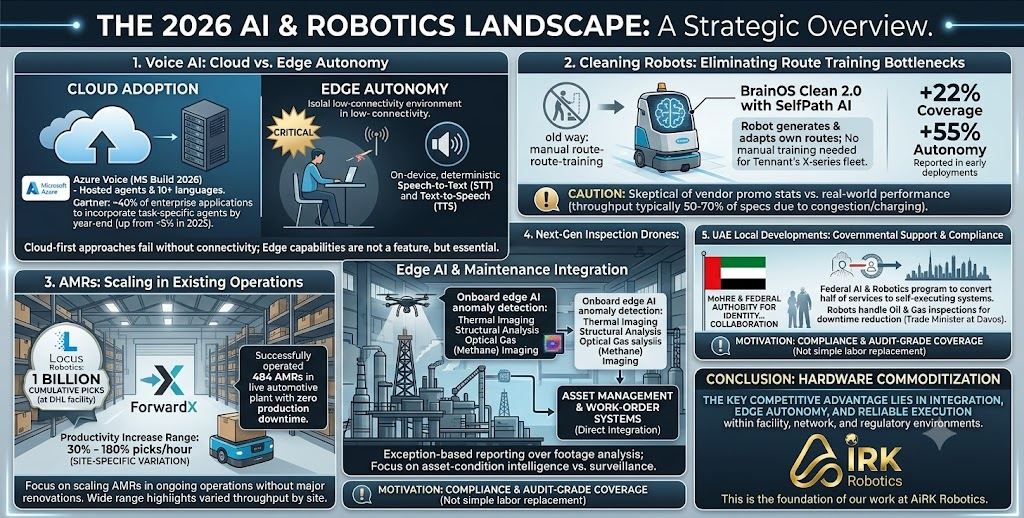
The 2026 AI & Robotics Landscape: A Strategic Overview

This analysis focuses on what is truly operational rather than just what has been announced.

1. Voice AI Consolidation. Voice AI is increasingly moving to the cloud. Microsoft made Azure Voice generally available at Build 2026, with hosted agents and a voice model supporting over 10 languages. According to Gartner, around 40% of enterprise applications are projected to incorporate task-specific AI agents by year-end, a significant increase from under 5% in 2025. This trend shows that major companies are betting on cloud-first solutions. However, this approach can be problematic if connectivity is lost. On-device, deterministic speech-to-text (STT) and text-to-speech (TTS) capabilities that operate locally without relying on the cloud are essential in low-connectivity situations. For these operations, this is not just a feature; it’s critical.

2. Cleaning Robots. The bottleneck in route training for cleaning robots is diminishing. Brain Corp has released BrainOS Clean 2.0 with SelfPath AI for Tennant’s X-series fleet, enabling robots to generate and adapt their own routes rather than needing manual operation on each route. Early deployments have reported gains of 22% in coverage and 55% in autonomy. This marks a significant inflection point in floor care for 2026, enabling faster deployment and eliminating the need for manual training. Nevertheless, it’s important to note that these figures, based on vendor measurements from initial rollouts, may not reflect actual performance in real-world scenarios, where throughput typically runs at 50–70% of advertised specs due to factors like congestion and charging. While the autonomy gain is real, it’s wise to be skeptical of the promotional statistics.

3. Autonomous Mobile Robots (AMR). Growth is occurring in existing facilities rather than brand new sites. Locus Robotics has achieved 1 billion cumulative picks, a milestone reached at a DHL location, which plans to expand to 5,000 robots across more than 40 facilities. They report that productivity can increase by 30–180% in terms of units picked per hour, with training time reduced by 80%. Additionally, ForwardX successfully operated 484 AMRs in a live automotive plant without any production downtime. However, the focus should be on the operational realities: scaling AMR use in ongoing operations without major renovations is crucial. The wide range of reported productivity (30–180%) indicates that throughput varies by site, and presenting a single figure may not provide the complete picture.

4. Inspection Drones. The latest autonomous inspection platform from Percepto features onboard edge AI anomaly detection. This platform can conduct thermal, structural, and optical gas imaging for methane, alerting users within an hour of detection and directly integrating findings into asset management and work-order systems. This architecture prioritizes exception-based reporting into maintenance systems rather than relying on human analysis of footage. Moreover, it focuses on asset-condition intelligence rather than surveillance, aligning with regulatory requirements. While the claimed detection accuracy exceeds 95%, it’s essential to inquire about the false-positive rate in real-world applications.

5. Local Developments. The UAE federal government has initiated an AI and robotics program through MoHRE, alongside the Federal Authority for Identity, Citizenship, Customs & Ports Security. This program aims to convert half of its services into self-executing AI systems, with a focus on robotics in logistics, manufacturing, and infrastructure. At the recent Davos conference, the trade minister mentioned that robots are already handling oil and gas inspections and maintenance to reduce production downtime. This indicates a shift in discussions from “why automate?” to “how quickly can we implement these changes?” However, the reality is that while there is strong governmental support for automation, that does not guarantee immediate deployment. In the Gulf region, the primary motivation for investment remains compliance and the maintenance of documented, audit-grade coverage, rather than simply replacing labor due to low labor costs.

Conclusion. The hardware landscape is becoming commoditized. The key competitive advantage lies in integration, edge autonomy, and reliable execution — effectively managing the systems that enable a robot to operate within specific facilities, networks, and regulatory environments. This is the foundation of our work at AiRK Robotics.

#Robotics #AutonomousMobileRobots #AMR #VoiceAI #DroneInspection #WarehouseAutomation #FacilityManagement #UAE

View original post ↗

Want to talk through what we build?

An assessment conversation is more useful than a feed of posts.