Stage: Pilot-stage deployment with partner-based hardware sourcing.
Move pallets and totes between stations without adding headcount WMS-connected, no new infrastructure.
The AiRK Autonomous Mobile Robot system automates internal material transport across warehouses, distribution centers, and manufacturing floors inbound-to-storage, storage-to-pick, pick-to-pack, and station-to-station delivery. It connects to your WMS for task assignment, coordinates a multi-robot fleet, navigates obstacles, and returns to dock without operator intervention.
Request Pilot DeploymentEngineered by the team behind 25 years of safety-critical firmware at Siemens Rail, Meta, GM, and 3M meet the team →
Data is processed on-device, not in the cloud see our security & compliance posture →
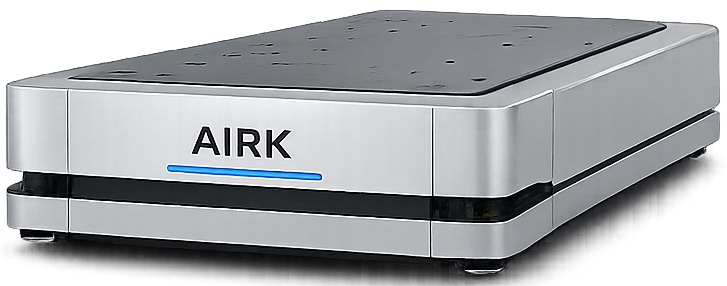
Partner-sourced hardware platform
The problem it solves
Warehouses, distribution centers, and manufacturing floors depend on constant internal material movement bins and pallets from inbound docks to storage, storage to picking stations, picking to packing lines, and finished goods between production stations. This work requires no judgment, only consistency and speed, but it consumes labor hours and creates throughput bottlenecks when done manually.
The AiRK AMR system replaces routine internal transport runs with autonomous operation: the robot receives a task from your WMS, plans the most efficient route, avoids obstacles and people, delivers the load, and returns to its docking station when done or when the battery is low.
What it covers
Primary use: Internal material movement (warehouses, distribution centers, manufacturing)
- Inbound-to-storage, storage-to-pick, pick-to-pack transport
- Station-to-station delivery on manufacturing floors
- WMS-connected task assignment and inventory tracking
- Multi-robot fleet coordination
AMR vs manual transport teams
| AiRK AMR System | Manual transport team | |
|---|---|---|
| Task consistency | Same route, same speed, every run | Operator-dependent |
| Operating hours | Any shift, including overnight | Shift-constrained |
| Scale-up cost | Add robots | Hire more staff |
| Reporting | Automatic task-completion logs | Manual |
| Multi-facility | Centrally managed | Per-site management |
System architecture
Navigation
LiDAR-based SLAM · dynamic obstacle avoidance · real-time path planning · automatic return-to-dock
Fleet intelligence
Multi-robot coordination · task allocation · traffic optimization · remote monitoring
Integration
WMS · ERP · warehouse management systems · reporting dashboard
AiRK’s role
AiRK owns the AI orchestration layer, system integration, and deployment model. Hardware (robot chassis and transport module) is partner-sourced we select the platform best suited to your facility’s floor layout, obstacle density, and load requirements.
Business impact
- Consistent internal transport without reliance on manual labor availability
- Lower long-term material-handling cost per task at scale
- 24/7 operation: run during off-hours without overtime cost
- Reduced forklift/cart-related throughput bottlenecks and safety incidents
- Fleet scales in phases add robots as volume grows
Deployment markets
Primarily UAE and India in the near term, with US deployments from Year 2.
Includes
- AMR hardware (partner-based, load-type matched)
- Transport module (bin / pallet / cart configuration)
- Navigation and mapping system (LiDAR + AI)
- Fleet-management software
- WMS/ERP integration
- Deployment, facility mapping, and testing
Excludes
- Building infrastructure changes or raised flooring
- Conveyor or fixed-automation installation
- Custom warehouse management software
- Floor cleaning see Autonomous Cleaning Robots for that use case
Regulatory note
AMR deployment in UAE is subject to relevant municipal and facility safety guidelines. In India, local authority approval may be required depending on the facility type. AiRK supports customers in meeting applicable requirements specific requirements are confirmed per site during pilot scoping.
